
Small bathrooms don’t need to apologize; they just need better lighting. The right mix of glow and shadow can stretch walls, lift ceilings, and make tile sing. Below, we reveal 12 small bathroom lighting ideas that make it feel bigger—each a fully realized room concept with finish-level details and editor-backed guidance.
1. Skylit Oasis With Backlit Onyx Vanity
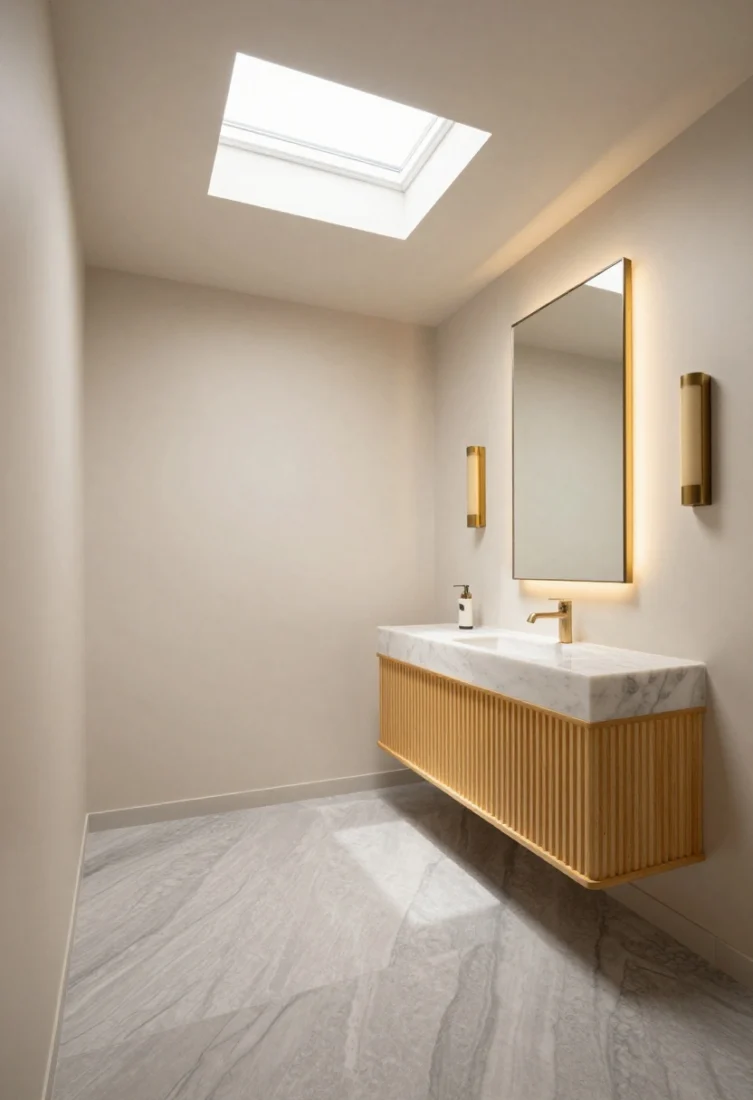
Imagine stepping into a petite bath where daylight floats in from a streamlined skylight and pools across a marble floor like water. Beneath a slender mirror, a ribbed onyx vanity front is softly backlit, casting a warm honeyed halo that makes the wall feel infinitely deep. In a compact footprint, verticality is everything: a tall, portrait mirror lifts the eye; slim, fluted sconces flank it like exclamation points. The palette stays whisper-light—ivory plaster walls, cloud-gray porcelain floor, brushed brass accents—to amplify reflectivity and minimize visual noise. The light story is layered and purposeful: skylight for ambient, backlight for glow, sconces for task. The result is a bathroom that feels taller, wider, and far more expensive than the square footage suggests.
- Key finishes: Backlit onyx, brushed brass, ivory plaster
- Lighting types: Skylight ambient, LED backlight, vertical sconces
- Shop cues: Fluted sconces, dimmable LED strips, ribbed stone-look vanity fronts
Why it works: Backlighting creates depth through perceived recession, while vertical lighting lines elongate the wall plane. Contrast is gentle, so the eye glides without interruption.
2. Mirror-Walled Jewel Box With Perimeter Coves
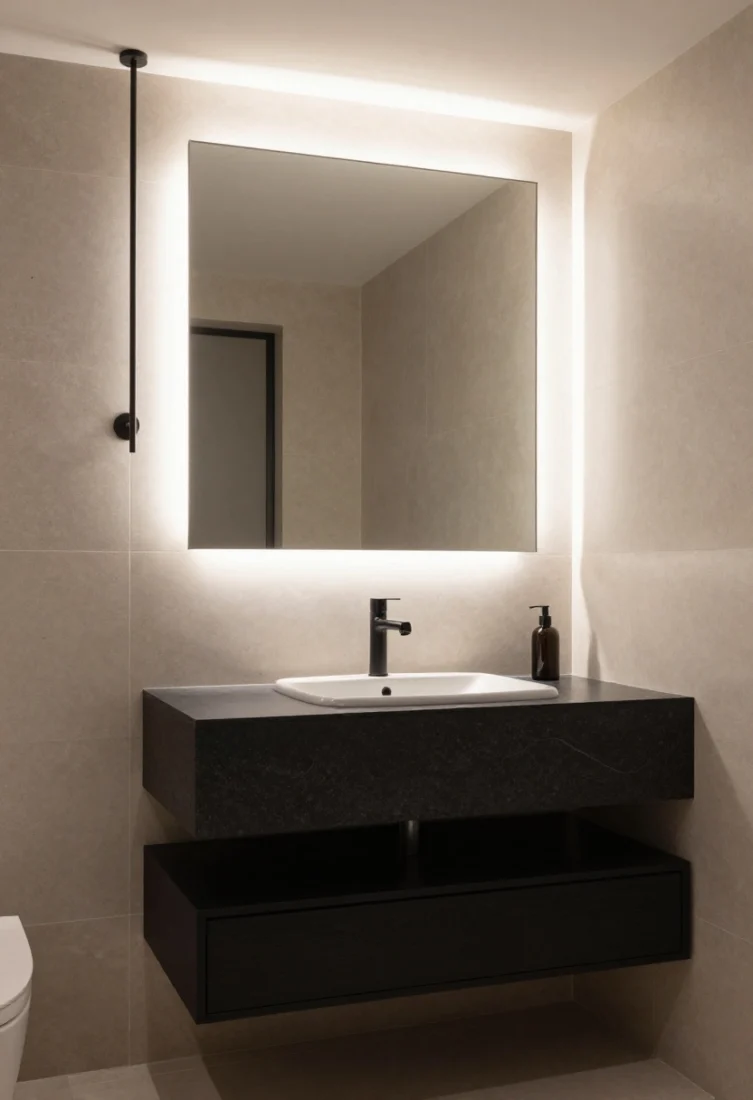
This design turns the mirror into architecture. A custom mirror clads an entire wall behind a floating vanity, its edges tucked into an LED cove that washes the perimeter with soft, continuous light. The mirror expands the room in both directions—width and depth—while the cove eliminates harsh shadows that can truncate space. The vanity floats in matte black oak, a slender ribbon against large-format pale limestone tile, and the sink is a petite vessel in glossy white porcelain set atop a soapstone slab. A needle-thin linear pendant drops in front of the mirror for crisp task lighting, its reflection doubling the drama.
- Key finishes: Matte black oak, pale limestone, soapstone
- Lighting types: Perimeter LED cove, linear pendant, concealed toe-kick LEDs
- Shop cues: Seamless mirrors, low-profile cove channels, linear suspensions
Why it works: The continuous cove softens edges and lifts the ceiling, while the mirror multiplies light and visually dissolves a boundary. Balance is maintained by grounding dark wood against luminous stone.
3. Coastal White Box With Ribbed-Glass Window Sconces
In a tight beach bungalow bath, a near-monochrome scheme—chalky white walls, honed white quartz vanity, sand-hued microcement floor—becomes sculptural under the right light. Ribbed-glass sconces shaped like vintage ship lanterns flank a shallow medicine cabinet, their directional glow diffused and flattering. Above, a white-plaster semi-flush dome with a linen diffuser throws a gentle, room-wide wash. The shower uses a clear glass panel (no frame) to keep sightlines broad; a niche lit from the top with a miniature LED grazes handmade zellige tile so every ripple gleams like sea foam.
- Key finishes: Honed quartz, microcement, white plaster
- Lighting types: Ribbed-glass sconces, linen-diffused ceiling light, niche grazer
- Shop cues: Marine-style sconces, plaster domes, clear glass shower panels
Why it works: Low-contrast color plus diffused light flattens visual clutter, while ribbed glass adds texture that catches light. Scale is restrained, keeping fixtures visually slim and the room serene.
4. Noir Powder Room With Gilded Glow
Dark can make small feel grand—if the light is warm and layered. Picture a graphite Venetian plaster envelope and a slender pedestal sink in honed Nero Marquina. A pair of petite, tapered-linen sconces with antique brass backplates bathe the face in flattering, candlelike light, while a hidden LED strip under the sink makes it float. Overhead, a shallow drum fixture with a gold-leaf interior casts a champagne glow that bounces off plaster, softening the depth. A frameless, slightly convex mirror subtly distorts and expands the reflection, with a brass edge that catches and amplifies the light like jewelry.
- Key finishes: Graphite plaster, Nero Marquina, antique brass
- Lighting types: Warm-linen sconces, gold-leaf drum, concealed under-sink LEDs
- Shop cues: Tapered-linen shades, convex mirrors, leafed-ceiling fixtures
Why it works: Controlled contrast creates drama without shrinkage, and warm reflective metals prevent the space from feeling cave-like. Balance comes from equally weighted vertical and overhead light.
5. Japandi Wet Room With Linear Grazers
A compact combined shower and bath zone is framed in pale oak slats and off-white tadelakt, with floor-to-ceiling glass that keeps the footprint legible. Lighting is deliberately linear: an LED grazer runs vertically along one wall to emphasize height, while a second grazes horizontally behind a floating oak shelf to stretch the room visually. The vanity is integrated—an oak trough with a thin, porcelain integral sink—paired with a rimless mirror that sits flush to the wall. The palette stays tactile: river pebble mosaic in the shower floor, matte black fixtures, and a single stone stool. The overall effect is spa-like and irresistibly calm.
- Key finishes: Tadelakt, pale oak, river pebble
- Lighting types: Vertical wall grazer, floating shelf backlight, mirror-integrated task
- Shop cues: Slim LED channels, oak slat panels, integral-sink vanities
Why it works: Linear light emphasizes the longest dimensions—height and length—creating optical spaciousness. Texture is gentle, so shadows add softness not clutter.
6. Parisian Niche Bath With Prismatic Pendants
Think Haussmann charm scaled for a studio: creamy panelled walls, marble hex tile, and a tiny curved shower enclosure. To avoid crowding the vanity, two petite prismatic pendants hang close to the wall on either side of a gilt-trimmed mirror, their refractive glass scattering light broadly. A slim picture light mounted above the mirror adds a subtle wash that highlights the paneling and draws the eye upward. Under the floating vanity, a toe-kick glow grazes chevron marble, visually extending the floor plane.
- Key finishes: Cream paint, chevron marble, antiqued brass
- Lighting types: Prismatic pendants, picture light, toe-kick LEDs
- Shop cues: Small-scale pendants, gallery picture lights, curved shower screens
Why it works: Refractive glass increases brightness without visual bulk, while layered uplight and downlight articulate classic details and verticality. Scale is tailored so fixtures read delicate, not busy.
7. Minimal Concrete Cube With Halo Mirror
Raw but refined: a micro-cement cube with a monolithic integrated sink, matte black fixtures, and a single circular mirror that floats on a halo of pure, even light. The mirror’s 360-degree backlight eliminates harsh facial shadows and makes the wall appear to recede, enlarging the perceived depth. A wafer-thin ceiling panel provides broad ambient illumination, more skylight than fixture, while a tiny directional spot over the WC keeps function discreet. With no color shifts—just layered grays and a touch of black—light becomes the hero.
- Key finishes: Micro-cement, matte black, smoked glass
- Lighting types: Backlit halo mirror, ultra-thin ceiling panel, discreet spot
- Shop cues: Rimless halo mirrors, panel lights, micro-cement kits
Why it works: Even, shadow-free lighting maximizes clarity and spatial calm. The circular mirror contrasts the rectilinear shell, balancing geometry and softening edges.
8. Botanical Powder Room With Uplights and Dappled Shadows
In a tiny powder room, pattern can be powerful when lit correctly. Hand-painted botanical wallpaper wraps the walls, but instead of blasting it with overhead light, small recessed uplights at the baseboards push light upward, creating a soft, gallery-like aura. A narrow marble console sink floats against the pattern, while a slender, reeded-glass sconce sits on the mirror, delivering focused, flattering task light. A small ceiling canopy with adjustable pin spots is aimed to let foliage motifs dance with gentle shadow, creating movement and depth without chaos.
- Key finishes: Hand-painted wallpaper, slim marble console, reeded glass
- Lighting types: Baseboard uplights, mirror-mounted sconce, adjustable pin spots
- Shop cues: Mini uplights, reeded-glass fixtures, console sinks
Why it works: Uplighting elongates the walls and reduces glare. By controlling highlight and shadow, the pattern reads dimensional, not busy, which visually enlarges the room.
9. Scandinavian White + Birch With Sunlight Simulation
For windowless baths, a tunable circadian panel can be transformative. Here, a luminous ceiling panel set to a soft daylight temperature mimics a skylight, reflecting onto matte white limewash and bouncing down to a pale birch vanity with integrated pulls. Vertical opal-glass sconces bracket a wide mirror, ensuring even face light. A micro-lip shelf with an LED underside extends wall-to-wall, visually broadening the space and providing a soft nightlight. Pebbled porcelain tiles add just enough texture to catch the light without visual clutter.
- Key finishes: Limewash white, birch veneer, pebbled porcelain
- Lighting types: Tunable ceiling panel, vertical opal sconces, shelf underglow
- Shop cues: Circadian panels, opal tube sconces, wall-to-wall shelves
Why it works: Color temperature control maintains a bright feel without harshness; uninterrupted horizontal lines widen a narrow room. Materials remain matte to prevent glare and over-bright hotspots.
10. Polished Stone Sanctuary With Recessed Framing
In a narrow ensuite, large-format Calacatta porcelain slabs run from floor to ceiling, their veining aligned to feel architectural. Lighting is precise: shallow recessed downlights placed near the walls wash stone with a soft cascade, framing the room and lifting the vertical planes. A custom, edge-lit mirror with integrated magnification provides crystal-clear task light without extra fixtures. To prevent a tunnel effect, a slim LED embedded in the shower threshold casts a discrete line of light that visually lengthens the floor. Brass fittings gleam just enough to punctuate the calm.
- Key finishes: Calacatta-look slabs, satin brass, clear glass
- Lighting types: Wall-wash downlights, edge-lit mirror, threshold strip
- Shop cues: Shallow gimbal downlights, edge-lit mirrors, porcelain slabs
Why it works: Wall washing brightens perimeters, pushing walls outward. Large-format slabs reduce grout lines, so light reads as expansive surfaces rather than a grid.
11. Art Deco Glow With Tiered Sconces and Gloss Lacquer
This petite bath leans glamorous: deep teal high-gloss lacquer wraps the walls, contrasted by a scalloped marble vanity and polished nickel fixtures. The lighting cues come from Deco theaters—two-tiered frosted sconces with stepped backplates cast a vertical ribbon of light, and a shallow, ribbed-glass flush mount glows like a halo at the ceiling. High gloss reflects and multiplies light while the frosted glass diffuses it, balancing sheen with softness. A slim brass shelf below the mirror hides an LED strip that spotlights crystal perfume bottles and keeps the vignette feeling couture.
- Key finishes: Teal gloss lacquer, scalloped marble, polished nickel
- Lighting types: Tiered frosted sconces, ribbed-glass flush mount, shelf LED
- Shop cues: Deco sconces, ribbed-glass ceiling lights, lacquer-friendly primers
Why it works: Gloss surfaces amplify light, and tiered lighting pulls the eye upward. The interplay of reflection and diffusion creates depth without glare.
12. Rustic-Luxe Cabin Bath With Candlelight LED and Copper
A small mountain bath needn’t feel heavy. Here, knot-free oak cladding is wire-brushed and limed to keep it bright, set against a hammered copper basin on a stone console. Lighting channels the romance of a candlelit lodge—LED “flame” sconces with realistic flicker flank the mirror, while a concealed strip above the shower beam uplights the pitched ceiling, visually increasing volume. A narrow window is mirrored opposite with a reflecting panel to bounce daylight deeper into the room. The shower niche gets a warm-toned micro-spot that highlights rough stone, bringing texture to life.
- Key finishes: Limed oak, hammered copper, split-face stone
- Lighting types: Candle-mimic sconces, ceiling uplight, warm niche spot
- Shop cues: Flicker-effect LEDs, beam-mounted strips, hammered metal basins
Why it works: Warm, directional light flatters natural materials and animates textures that might otherwise read heavy. Uplighting celebrates height and opens the envelope.
Design Principles That Make Small Bathrooms Feel Bigger
- Layered lighting: Combine ambient, task, and accent to avoid flatness and harsh shadows.
- Vertical emphasis: Use sconces, grazers, and tall mirrors to elongate walls.
- Reflectivity with restraint: Mirrors and gloss amplify light; balance with matte textures to prevent glare.
- Continuous lines: Wall-to-wall shelves, floating vanities, and perimeter coves stretch the eye.
- Warmth and dimming: Warm temperatures and dimmers add depth and evening comfort without losing clarity.
Quick Shopping Checklist
- Task lights: Vertical sconces, edge-lit mirrors, linear pendants
- Ambient layers: Flush mounts with diffusers, tunable ceiling panels, perimeter coves
- Accent tools: LED strips for niches and toe-kicks, mini uplights, wall grazers
- Finishes: Brushed brass, polished nickel, matte black; select one hero metal and one support
- Surfaces: Large-format porcelain, plaster or limewash, ribbed or reeded glass for texture
Conclusion
A small bathroom doesn’t need more square footage; it needs a smarter light story. Start with even ambient light, add vertical task lighting at the mirror, then layer subtle accents that stretch lines and celebrate texture. With the right balance of glow, reflection, and restraint, your smallest room can feel expansive—and exquisitely polished.
FAQ
Q: What color temperature is best for small bathroom lighting?
A: Aim for 2700K–3000K for a warm, flattering look at the mirror, and consider 3500K ambient if you prefer a brighter daytime feel. Keep temperatures consistent within each layer to avoid mismatched tones.
Q: How many lighting layers should a small bathroom have?
A: Three is ideal—ambient (overall), task (mirror), and accent (niches, coves, uplights). Even in very tight spaces, a task + ambient combo plus one subtle accent dramatically improves perceived size.
Q: Are backlit mirrors better than sconces?
A: They’re excellent for even, shadow-free light and tight layouts, but the most flattering results come from pairing a backlit mirror with vertical sconces or a linear pendant to add dimension and sparkle.
Recommended Products
Disclosure: As an Amazon Associate, this site may earn from qualifying purchases.
These affiliate-ready categories are broad, safe shopping prompts readers can use to build the look without fake pricing or made-up reviews.
- Shadow-free task — Even face lighting and makes walls feel deeper.
- Elongate walls — Flanks mirrors to stretch height and improve grooming.
- Lift ceilings — Soft, continuous glow removes harsh edges and expands space.
- Skylight effect — Broad ambient wash mimics daylight in windowless baths.
- Subtle accents — Great for niches, toe-kicks, and shelves to widen floors.
Shop the Look on Amazon: Give readers a fast path from inspiration to action.