
Your small bathroom doesn’t need more square footage—it needs smarter moments of beauty and order. Peek inside nine compact, high-functioning baths that feel twice their size thanks to surreptitious storage and design sleight of hand. This edit of small bathroom storage ideas that double your space blends elevated materials, layered lighting, and clever architecture so every inch works hard—and looks calm.
1. The Luxe Medicine Wall: A Mirror That Works Overtime
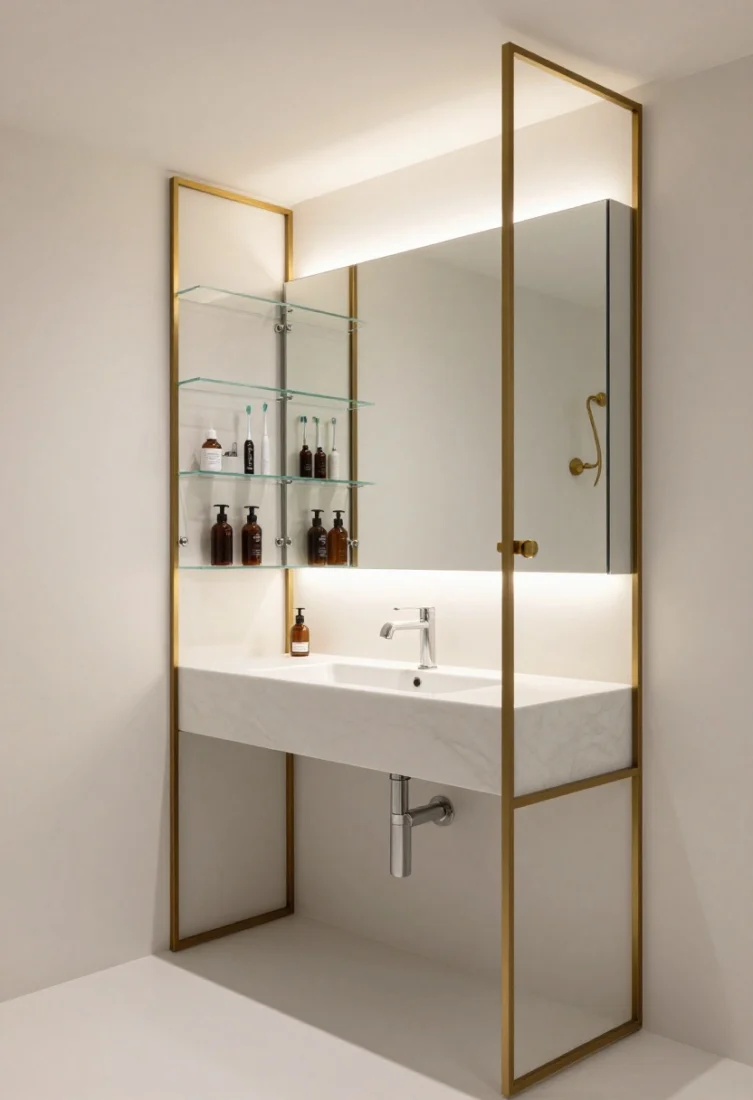
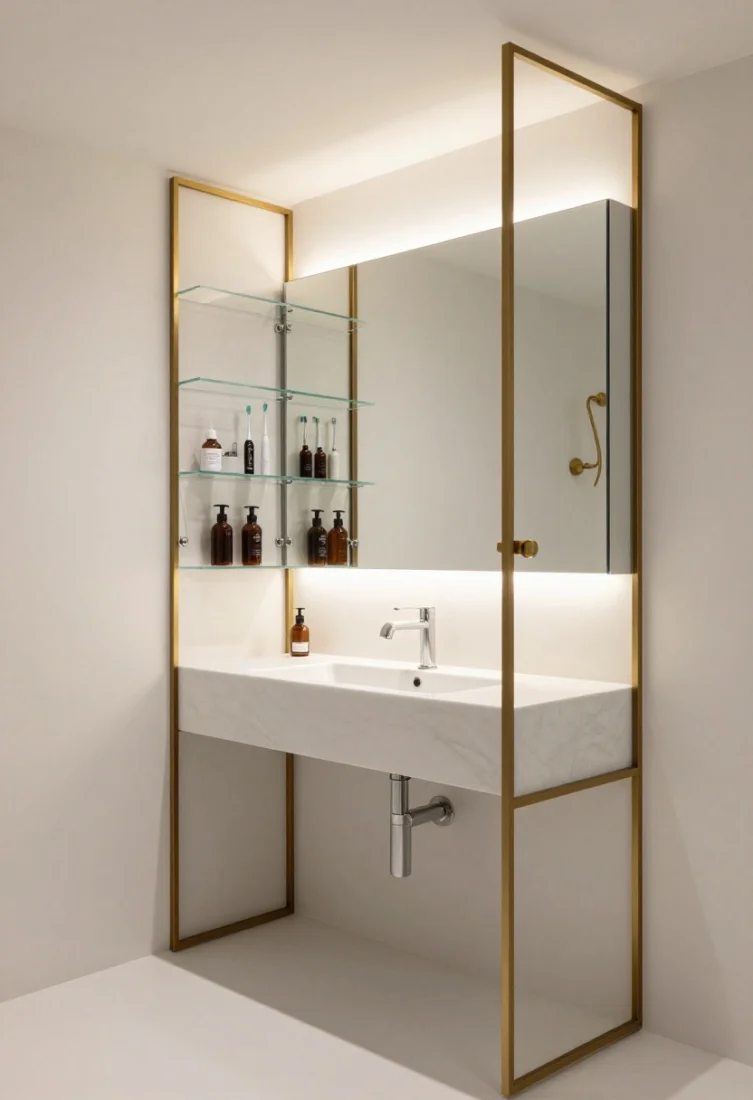
Imagine stepping into a compact bath where a broad mirror floats wall-to-wall, its surface clean as a gallery panel. Touch the edge and—click—panel doors whisper open to reveal a recessed pharmacy of daily essentials. This is the “luxe medicine wall”: a custom, built-in mirror cabinet, framed in slim satin-brass and wrapped with sculptural sconces. The cabinet is recessed between studs to maintain a razor-thin profile, with adjustable glass shelves and integrated charging for electric toothbrushes and trimmers. Below, a porcelain console sink appears weightless, leaving floors clear and airspace generous.
Why it works: scale and reflectivity. A mirror spanning the full width visually doubles the room, while hidden depth swallows clutter. Brass trim adds warm contrast to cool porcelain, and the layered light—sconces at eye level plus an LED strip tucked under the mirrored lip—balances task and ambient illumination, preventing harsh shadows in a tight footprint.
- Palette: soft white walls, unlacquered brass, clear glass, and honed Carrara.
- Storage plays: recessed mirrored cabinet; shallow shelves sized for skincare bottles.
- Shop cues: custom mirrored medicine cabinets, slimline wall sconces, glass shelf risers.
2. The Spa Tower Niche: Floor-to-Ceiling Quiet Storage
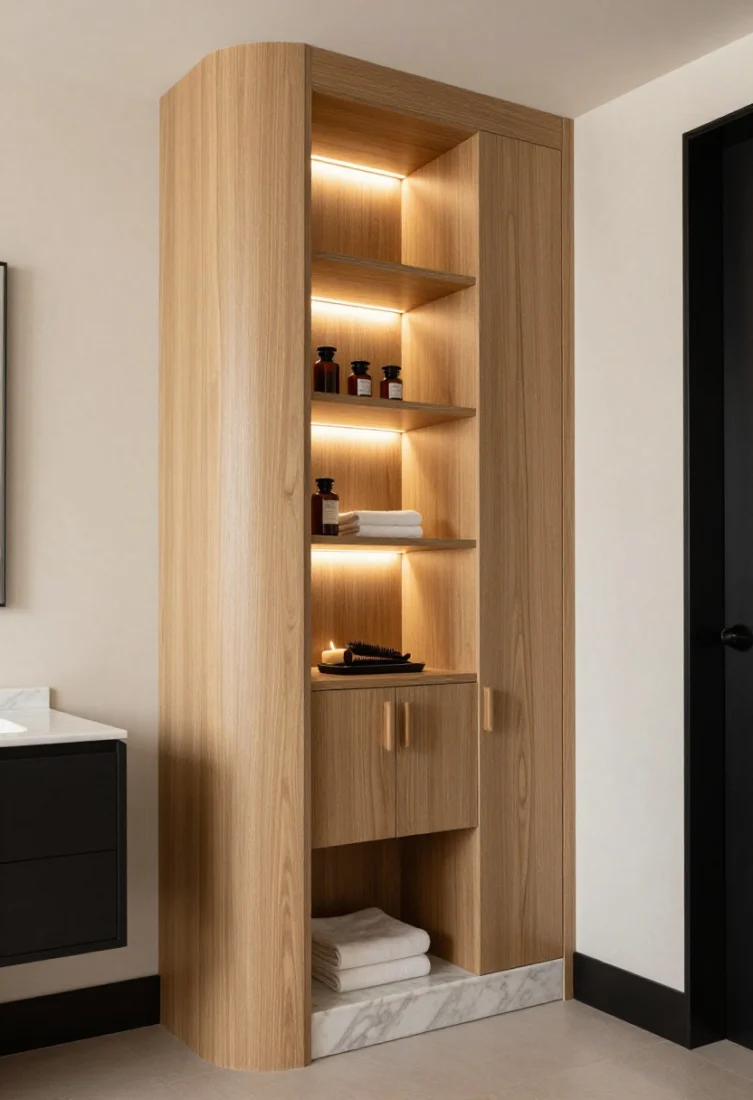
For a bathroom starved of cabinetry, carve a tall niche beside the vanity and treat it like a serene spa tower. Clad the interior in vertical, moisture-resistant oak veneer to deliver warmth and linear texture. Fit the niche with fingertip-pull doors at the bottom and open shelves above—backlit with a soft LED ribbon that glows like candlelight. Apothecary jars, neatly folded hand towels, and a discreet tray for hair tools live here, all within arm’s reach yet visually calm.
The design principle at play is rhythm: repeating the vertical grain of the oak with the height of the tower draws the eye upward, making the ceiling feel higher. Closed storage anchors the base (visual weight low = stability), while open shelves keep the tower from reading heavy. A slim marble threshold at the niche base nods to the vanity top, tying materials together.
- Palette: creamy plaster, light oak, pearl marble, matte black accents.
- Storage plays: mixed open/closed tower; hidden power outlet; lidded baskets.
- Shop cues: modular tall cabinets, LED tape lights with diffusers, apothecary jars, woven bins.
3. The Sliding Vanity Drawer With Divided Depths
Trade a clunky under-sink cabinet for a floating vanity with two deep, full-extension drawers engineered around the plumbing. The top drawer uses a U-shaped cutout to dodge the drain yet still holds everyday items using fluted acrylic dividers; the bottom drawer conceals taller skincare and styling tools. A sleek porcelain slab sink sits atop the vanity, with a wall-mounted faucet freeing up counter space and eliminating the need for a deck plate.
Function meets finesse through balance: the weight of the vanity is visually lightened by the floating mount, exposing more floor tile and extending sight lines. The drawers’ organized interiors create a ritual-friendly flow—morning items at the front, backups tucked in the back. Integrated drawer lighting, triggered by motion sensors, turns the cabinet into quiet theater.
- Palette: smoked walnut veneer, matte ivory sink, antiqued brass faucet.
- Storage plays: double-drawer vanity; custom organizers; motion-activated lighting.
- Shop cues: floating vanities with plumbing cutouts, modular drawer inserts, wall-mount faucets.
4. The Over-Toilet Gallery Rail: Slim, Airy, and Architecturally Clean
Space above the toilet often becomes a design afterthought. Reimagine it with a gallery-style rail system: two or three ultra-slim white oak shelves supported by nearly invisible brass pins or a channel. Keep the composition minimal and disciplined—stacks of guest towels, a sculptural vase, a lidded canister. The back wall is tiled in a textured, hand-molded ceramic that adds shadow and depth, offset by a small framed photograph to soften the grid of tile.
Contrast delivers the win: the tactile tile plays against sleek shelving, while the warm oak contrasts with cool ceramic. Keep negative space around each object to avoid clutter creep; think boutique-hotel restraint. Use the lowest shelf for small canisters and scent, mid-shelf for folded towels, and top shelf for an accent piece to pull the eye upward and expand perceived height.
- Palette: warm white tile, white oak, soft brass, charcoal photo frame.
- Storage plays: shallow open shelves; coordinated containers; vertical stacking.
- Shop cues: floating picture ledges, brass shelf pins, ceramic storage canisters.
5. The Shower Cloakroom: Recessed Ledges and Hidden Hooks
Inside the shower, maximize storage without visual clutter. Replace a single large niche with a trio of slender, horizontal ledges carved into the wall tile—the lowest for razors and soap, the middle for bottles, the top for a small plant or face cloths. Build a recessed hook panel just outside the shower door, finished in the same tile, with minimal brass pegs. The effect is architectural and calm: everything has a home, but nothing interrupts the plane of the wall.
Texture and lighting set the mood. Softly ribbed tile adds grip and interest; a linear drain keeps the floor seamless. Concealed waterproof LED strips at the underside of each niche lip provide a spa-grade glow, while the brass pegs lend a jewel-like counterpoint to the matte tile. The rhythm of repeated narrow ledges elongates the sightline, visually lengthening the shower.
- Palette: fog-gray ribbed tile, matte brass, clear glass.
- Storage plays: multiple slim niches; recessed hook panel; linear drain for continuity.
- Shop cues: waterproof LED tape, tile-mounted hooks, narrow niche trims, squeegee with wall clip.
6. The Pocket-Laundry Vanity: Concealed Hampers and Towel Warming
If laundry piles are kneecapping your bathroom’s serenity, build them into the plan. Flank a narrow vanity with dual tilt-out hamper cabinets lined in washable canvas bags—lights on one side, darks on the other. Above, a shallow cabinet conceals a heated towel rail that slides out like a pantry pull, drying hand towels without a hulking bar on display. The vanity is faced in fluted oak, whose vertical grooves add movement without bulk.
Here, flow and zoning are the heroes. Daily rhythm is simplified by contiguous stations: sink for washing, pull-out for drying, tilt-out for sorting. The fluting’s repeating lines introduce scale-appropriate texture that reads high-end yet forgiving. A matte stone top with a pencil edge keeps the look tailored, while under-cabinet toe-kick lighting creates an elegant hover and doubles as a nightlight.
- Palette: fluted light oak, greige stone, brushed nickel, soft white walls.
- Storage plays: dual tilt-out hampers; slide-out towel warmer; toe-kick lighting.
- Shop cues: tilt-out hamper frames, pull-out towel warmers, canvas liner bags, fluted panel fronts.
7. The Hotel Cart Redux: Mobile Apothecary on Locking Casters
Where built-ins aren’t possible, introduce a refined, mobile solution. A two-tier cart with slim, lacquered shelves and brass gallery rails tucks beside the sink or under a window. Use the top tier for daily skincare and fragrance on a marble tray; the lower tier holds spare towels and a petite lidded bin for cotton rounds. Locking casters keep it planted; unlock and roll it beside the tub when you want a spa-night caddy.
This design banks on flexibility—scale and movement tuned to a small footprint. The cart’s negative space keeps it airy; the rails corral items without visual heaviness. Style it with a disciplined palette: decant bath salts and soaps into matching glass; use one accent color—perhaps deep green eucalyptus—to avoid visual noise.
- Palette: high-gloss ivory, aged brass, white towels, clear glass, green sprig.
- Storage plays: mobile shelves; trays within tiers; decanting for visual calm.
- Shop cues: narrow bar carts, marble catchall trays, locking casters, glass pump bottles.
8. The Under-Window Vanity Bench With Hidden Drawers
Windows in small baths can limit cabinet placement; turn that challenge into a luxurious ritual station. Build a low, upholstered vanity bench beneath the window, flanked by two slim drawer stacks. The bench lid lifts to reveal a shallow compartment for hair tools and brushes, with heat-resistant lining. Drawers on either side store cosmetics, travel kits, and extra tissue. Overhead, a narrow shelf aligns with the window sill to hold a small mirror, preserving light and view.
Proportion and comfort elevate this layout. By keeping storage below sill height, you maintain sunlight and a sense of openness. A performance fabric in a subtle herringbone adds tactile richness; the drawer faces echo the main vanity finish for cohesion. Add a plug-in sconce with a translucent shade to avoid blocking the window, and your morning prep zone becomes a sunlight ritual.
- Palette: pale linen upholstery, warm walnut drawers, polished nickel hardware.
- Storage plays: lift-up bench compartment; flanking drawers; sill-aligned shelf.
- Shop cues: heat-resistant drawer liners, low-profile pulls, performance textiles, plug-in sconces.
9. The Ceiling-High Cabinet With Pocket Doors and Display Ledge
In truly tight plans, chase the ceiling. Install a tall, shallow cabinet (think 10–12 inches deep) that spans floor to ceiling and runs the length of a short wall. Fit pocket doors that slide into the casework so doors never swing into the room. Inside, mix adjustable shelving with two pull-out trays lined for hair tools and first-aid; reserve one waist-height shelf as a “daily station” for skincare. Outside, a slim marble display ledge runs along the cabinet’s face at mid-height for a candle and a single sculptural object—elevated, never cluttered.
Verticality is your amplifier here. The uninterrupted column of storage lifts the eye, while the pocket doors eliminate conflict with traffic flow. Color-match the cabinet to the wall for a seamless plane, then let the marble ledge and hardware bring a hint of luxe. Crown the cabinet with a shallow uplight trough to create a soft halo that makes the ceiling feel higher and the room calmer.
- Palette: color-matched lacquer (stone gray or bone), thin Calacatta ledge, satin brass pulls.
- Storage plays: shallow depth; sliding pocket doors; pull-out trays; integrated uplight.
- Shop cues: tall pantry-style bath cabinets, low-profile door tracks, slim marble shelves, LED uplights.
Design Playbook: How These Rooms Double Space
- Go vertical: Tall niches, tower cabinets, and full-height mirrors stretch the room upward.
- Float when possible: Floating vanities and toe-kick lighting reveal more floor, visually widening the plan.
- Repeat textures: Fluting, ribbed tile, and linear grain create rhythm that organizes the eye.
- Light in layers: Combine sconces, cabinet LEDs, toe-kicks, and uplights to soften corners and brighten tasks.
- Unify finishes: Two or three metals max; coordinate tones to avoid visual clutter.
- Discipline the display: Use decanted containers and consistent towels; spotlight one sculptural object.
Materials & Styling Notes That Elevate Small Spaces
Small bathrooms benefit from a curated material story. Pair a quiet, matte wall finish with one tactile moment—fluted wood, hand-molded tile, or a veined stone ledge—for richness without noise. Keep hardware slender and linear; let lighting bring the jewelry. Finally, style with restraint: a single sprig in a bud vase beats three competing florals. These subtle decisions build a luxury narrative that reads larger than the room itself.
Conclusion
Doubling a small bathroom is less about adding cabinets and more about choreographing them. Recess where you can, float what you must, and let lighting, texture, and proportion carry the room. With these nine storage-forward concepts, your smallest bath can feel serene, tailored, and—most importantly—effortlessly spacious.
FAQ
How do I choose finishes that won’t date quickly?
Stick to timeless bases—white or warm gray tile, natural stone, or stone-look porcelain—and layer character through hardware, lighting, and wood tones. These can be updated later without retiling.
What storage should be open versus closed?
Display only what adds beauty or is used daily. Keep backups, cleaning supplies, and appliances behind doors. Aim for a 70/30 split: mostly closed, with a disciplined slice of open storage.
Can I retrofit recessed storage in an existing bath?
Often, yes. Stud bays can host shallow cabinets or niches. Verify wall depth, plumbing, and electrical first, then use low-profile frames and tile trims to keep the look integrated and waterproofed.
Recommended Products
Disclosure: As an Amazon Associate, this site may earn from qualifying purchases.
These affiliate-ready categories are broad, safe shopping prompts readers can use to build the look without fake pricing or made-up reviews.
- Mirror storage — Hides clutter while visually doubling space
- Lifted storage — Opens floor sightlines and adds drawers
- Layered light — Backlights niches and cabinets for spa glow
- Slim shelving — Uses dead space for towels and canisters
- Ceiling-high — Maximizes vertical storage in tight rooms
Shop the Look on Amazon: Give readers a fast path from inspiration to action.