
Small bathrooms can feel like a luxury jewel box—or a missed opportunity. The difference comes down to strategic materials, lighting, and a few high-impact choices that trick the eye. If you’re chasing “small bathroom ideas that look expensive,” consider this your editor’s cut: richly layered, livable concepts that telegraph polish without shouting for attention.
As with any great room, the magic isn’t just what you pick—it’s how you balance shine with matte, warm with cool, line with curve, and light with shadow. Below, 13 fully realized mini makeovers prove that square footage is merely a constraint, not a compromise.
1. Marble Envelope With Brass Punctuation
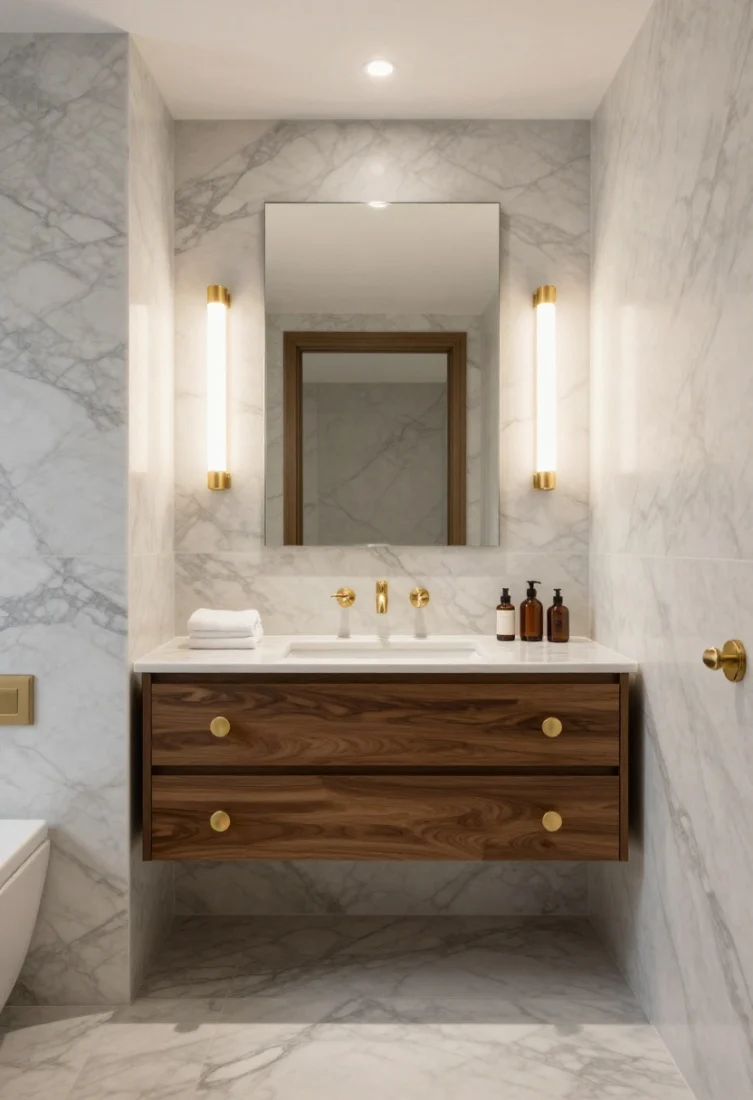
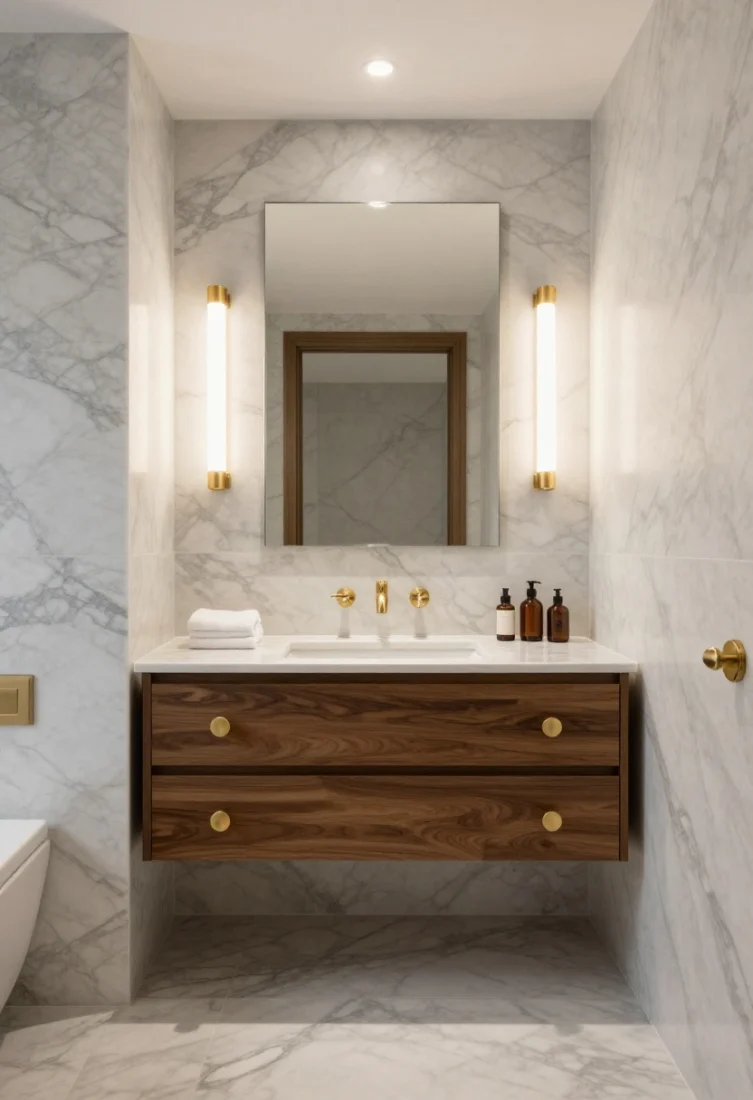
Think of this bathroom as a refined jewelry box: veined marble on walls and floors, wrapped seamlessly to blur edges and visually expand the footprint. A compact floating vanity in walnut grounds the cool stone with quiet warmth, while unlacquered brass fixtures act as punctuation—small hits of glow that patina gracefully over time.
- Palette: honed Calacatta or Arabescato marble, walnut, unlacquered brass.
- Lighting: a pair of slim brass picture lights flanking a beveled mirror for flattering vertical glow.
- Hardware: knurled brass pulls that echo the faucet’s geometry.
Why it works: The continuous stone envelope creates visual continuity—no choppy transitions—so the room feels larger. Balance matte (honed stone) with reflective (mirror, brass) to layer texture without visual noise. Shop cues: marble field tile and slabs, brass wall lights, solid-wood floating vanity, beveled mirror.
2. High-Contrast Monochrome With Architectural Lines
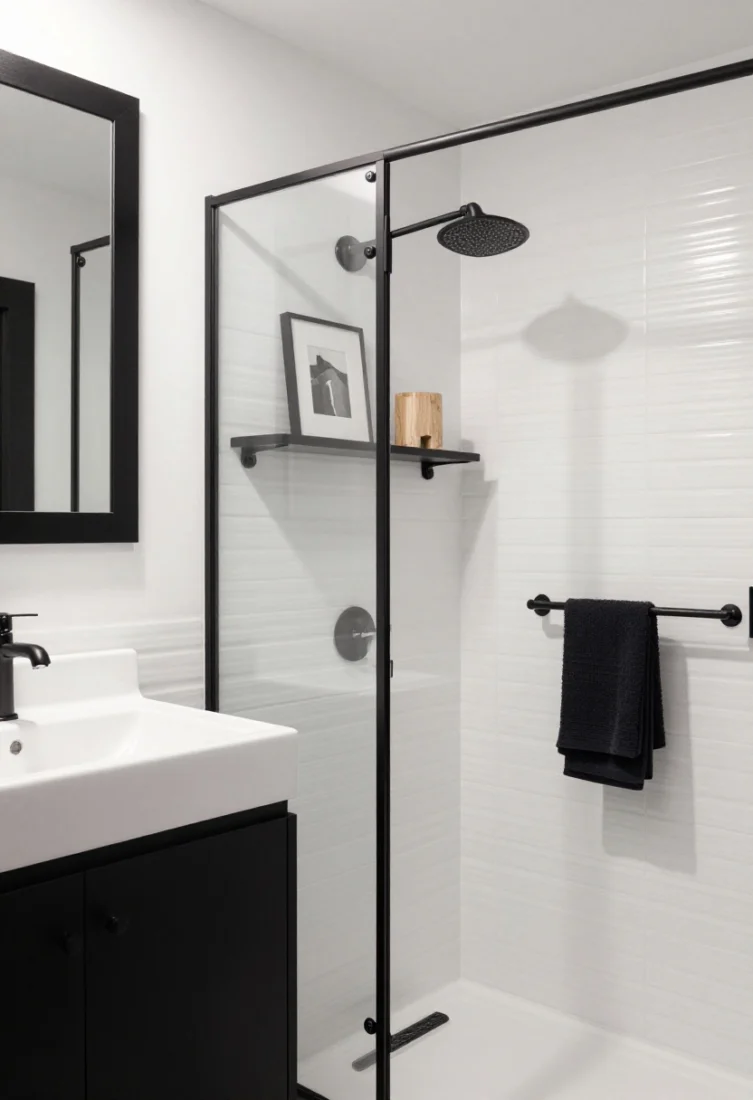
Start with a gallery-white shell, then draw crisp black lines where they’ll count: steel-framed shower screen, powder-coated shelf brackets, a skinny black-edge mirror. Keep the vanity minimal—think white lacquer with integrated sink—and introduce one tactile element, like ribbed ceramic tile in the shower.
- Palette: white, black, a single warm accent (oak stool or linen hand towel).
- Surfaces: ribbed or fluted white tile to catch shadow and add depth.
- Accents: small black-and-white art piece to underscore the theme.
Why it works: High-contrast edges sharpen the architecture and trick the eye into reading stronger proportions. The restrained palette feels editorial and expensive. Keep grout fine and precisely matched to minimize visual clutter. Shop cues: black-framed shower enclosure, fluted ceramic tile, thin-framed mirror.
3. Statement Stone Vanity, Quiet Everything Else
Invest in a compact vanity carved from a single block of stone—travertine, limestone, or soapstone—then let it be the star. Surround it with soft, tonal limewash walls and a micro-mosaic floor in a similar hue so the stone’s movement reads as art. Choose a wall-mounted faucet in brushed nickel to keep the silhouette clean.
- Palette: sandy beige, warm gray, or putty with subtle undertones.
- Lighting: a small alabaster sconce for a milky, diffused glow.
- Storage: slim recessed niche lined in the same stone.
Why it works: Scale and material hierarchy. One sculptural moment plus a chorus of whisper-quiet finishes feels editorial and deliberate. The wall-mount faucet frees surface area and keeps edges crisp. Shop cues: stone pedestal vanity, limewash paint, alabaster sconce, brushed-nickel wall-mount faucet.
4. Parisian Powder: Paneling, Chevron, and Crystal
In a petite bath, classic millwork is a shortcut to elegance. Apply half-height paneling painted in a moody blue-green, and lay narrow-plank oak in a chevron pattern (engineered wood with a proper moisture barrier). Above, hang a petite crystal flush mount that scatters light like jewelry. A marble-topped console sink on slender legs adds airiness.
- Palette: blue-green paneling, warm oak, soft white marble, polished nickel.
- Details: a gilt-framed vintage mirror for patina and history.
- Textiles: monogrammed linen hand towels and a petite Persian runner.
Why it works: The interplay of refined lines (paneling, chevron) and sparkle (crystal, gilt) builds richness without bulk. Open-leg sinks preserve negative space—critical in tight rooms. Shop cues: console sink with marble top, wainscot molding, crystal flush mount, vintage-style mirror.
5. Spa Minimalism With Japanese Warmth
Channel onsen serenity: vertical slatted cedar or teak cladding on one accent wall, warm-gray porcelain floors, and a shallow soaking tub or walk-in shower with a wood-look slatted mat. Keep fixtures blackened or oil-rubbed bronze. Hide storage behind flat-panel cabinetry in the same wood tone for a calming, continuous plane.
- Palette: warm woods, graphite gray, soft white, aged bronze.
- Lighting: dimmable cove lighting under the vanity and a simple rice-paper fixture overhead.
- Accessories: a stone bath stool, handmade ceramic tray, and eucalyptus for scent.
Why it works: Warm texture plus restrained form. The slatted detail adds rhythm and shadow play, while integrated lighting softens edges. It reads expensive because nothing shouts; everything aligns. Shop cues: teak wall cladding, large-format porcelain, oil-rubbed bronze fixtures, cove LED strips.
6. Glossy Jewel Box With Lacquered Walls
Small rooms love drama. Lacquer the walls and ceiling in a saturated color—inky teal, oxblood, or bottle green. Pair with a petite marble pedestal sink and antique brass swan-neck faucet. Tile the floor in a tiny checkerboard (charcoal and off-white) for vintage glamour, and add a convex mirror to amplify light and curves.
- Palette: deep jewel tone, antique brass, creamy marble.
- Lighting: prismatic glass sconce that sparkles against gloss.
- Hardware: aged brass switch plates and simple ring pull for balance.
Why it works: High-gloss surfaces bounce light and visually lift the ceiling. The small-scale checker anchors the gloss with graphic order. One or two luxe materials, used decisively, telegraph confidence. Shop cues: lacquer-quality paint, pedestal sink, prismatic glass lighting, convex mirror.
7. Coastal Quiet Luxury: Limestone and Linen
Picture a breezy suite by the sea—bleached oak vanity with cane-front doors, tumbled limestone floors, and matte white zellige tile in the shower. Keep the palette sun-faded: sand, shell, bone. Add linen cafe curtains and a driftwood-framed mirror for tactile softness. Finish with brushed stainless fixtures to maintain a cool, salty clarity.
- Palette: sands and shells with soft stainless notes.
- Textiles: thick Turkish towels, woven bath mat.
- Storage: woven baskets under the vanity for organic order.
Why it works: Texture over trend. The light-scattering quality of handmade tile and the irregularity of tumbled stone create depth in a quiet voice. Cane adds a whisper of pattern and airflow. Shop cues: zellige tile, cane-front vanity, limestone field tile, linen cafe panels.
8. Black Marble Drama With Linear Lighting
Make a small space unforgettable: vein-forward black marble (Nero Marquina or similar) in the shower, balanced by a matte plaster wall and a slim wall-hung vanity in smoked oak. Line the mirror with vertical LED sconces for editorial, shadowless light. Finish with gunmetal hardware to keep the palette tight and moody.
- Palette: black, charcoal, smoked oak, soft plaster gray.
- Lighting: 3000K vertical LEDs flanking the mirror for flattery.
- Floor: honed black hex for grip and subtle geometry.
Why it works: Controlled contrast and repetition. Dark stone recedes visually when balanced with strategic lighting and matte walls. The smoked oak softens the marble’s intensity. Shop cues: black marble tile, smoked oak vanity, linear LED sconces, gunmetal fixtures.
9. Heritage Pattern, Modern Silhouette
Embrace a patterned cement tile floor—think muted quatrefoil or geometric star—in a classic palette like slate, ecru, and sage. Keep the walls smooth and pale, but opt for a modern wall-mounted vanity with a clean integrated sink. Add a vintage oil painting and a slim picture rail to layer character without clutter.
- Palette: softly patterned floor with quiet walls.
- Fixtures: streamlined chrome or polished nickel to bridge eras.
- Storage: recessed medicine cabinet with an ultra-thin frame.
Why it works: Pattern draws the eye down and outward, broadening the footprint. Simplified silhouettes ensure the floor—your investment piece—gets the spotlight. Shop cues: encaustic-style tile, modern wall-hung vanity, thin-frame medicine cabinet, vintage art.
10. Mirror, Mirror, Everywhere: Reflective Illusion
Double the perceived width with a full-height mirror wall behind the vanity, then echo its rhythm with a mirrored cabinet inside the shower niche. Keep finishes light—porcelain terrazzo floor, pale oak vanity—and choose a slim spout faucet to avoid visual interruption. Add a micro-edge glass shelf for a single sculptural object.
- Palette: pale neutrals and mirrored surfaces.
- Lighting: backlit perimeter mirror plus a ceiling downlight for layers.
- Accents: a single stone vessel or branch for silhouette.
Why it works: Reflection expands space and multiplies light. Limiting the color range prevents the “fun house” effect and keeps it refined. Shop cues: full-height mirror panels, terrazzo-look porcelain, backlit mirrors, micro glass shelves.
11. Warm Metals and Fluted Glass Glow-Up
Introduce subtle glamour with fluted glass shower doors that blur shapes and bounce light, paired with champagne bronze or warm gold fixtures. A creamy microcement wall finish lends softness, while a ribbed-front vanity in walnut brings tactile structure. Add an arched brass-framed mirror to soften all the straight lines.
- Palette: cream, walnut, warm gold.
- Lighting: opal globe sconces for even, flattering diffusion.
- Floor: porcelain in a warm stone look for practicality.
Why it works: Diffusion and curve counterbalance the linear footprint of a small bath. Repeating ribbed/fluted elements reads cohesive and custom. Shop cues: fluted glass panels, ribbed-front vanity, globe sconces, champagne bronze fixtures.
12. Art-Led Powder With Moody Wallpaper
For a no-shower powder room, lean into artful impact: a moody mural or large-scale botanical wallpaper on all four walls, capped by a matte black ceiling. Anchor the pattern with a stone console sink and a slender black faucet. Let a single sculptural sconce—maybe alabaster or smoked glass—serve as the room’s pendant moment.
- Palette: mural tones plus black and natural stone.
- Mirror: frameless oval for soft edges.
- Hardware: black to recede and let the art shine.
Why it works: Scale fools the eye. Large patterns make walls feel farther apart, and a dark ceiling creates intimacy. With utilities pared back, every detail can be premium. Shop cues: mural wallpaper, stone console sink, sculptural sconce, matte black faucet.
13. Hotel-Suite Wet Room With Seamless Drain
Convert the entire footprint into a wet room: large-format porcelain on walls and floors with minimal grout, a linear drain, and a fixed glass panel instead of a swinging door. Float the vanity to free floor area and add underglow lighting. Choose a warm gray palette with brushed stainless and a teak shower bench for spa credibility.
- Palette: soft gray, teak, brushed stainless.
- Tile: 24×48-inch porcelain slabs for near-seamless planes.
- Lighting: ceiling rain shower plus dimmable vanity task lighting.
Why it works: Continuity is luxury. Removing thresholds streamlines the room and makes it feel larger. The linear drain and large slabs deliver a custom, hotel-grade finish. Shop cues: porcelain slabs, linear drain, fixed glass panel, teak bench.
Design Principles That Make These Rooms Feel Expensive
- Material hierarchy: One hero material supported by quiet companions.
- Light layering: Combine task, ambient, and accent light to soften edges.
- Scale and negative space: Open-leg or floating elements preserve airiness.
- Texture balance: Pair matte with gloss, smooth with ribbed, hard stone with soft textiles.
- Cohesive hardware: Finish consistency creates a custom look.
Smart Styling Touches That Elevate, Instantly
- Upgrade the mirror: bevels, arches, metal frames, or full-wall spans.
- Swap lighting: vertical sconces at eye level outperform overheads alone.
- Curate textiles: heavyweight towels, linen hand towels, and a small vintage rug.
- Contain clutter: matching apothecary bottles and a lidded tray feel intentional.
- Add greenery: a single branch or small fern punctuates all that stone and tile.
What to Buy (Broadly) When You Want the Look
- Surfaces: marble or marble-look porcelain, limestone, terrazzo, zellige, microcement.
- Fixtures: wall-mounted faucets, slim-profile toilets, linear drains, steel-framed screens.
- Lighting: alabaster or opal sconces, picture lights, backlit mirrors, prismatic glass.
- Furnishings: floating vanities, console sinks, teak benches, cane-front storage.
- Details: unlacquered brass or gunmetal hardware, fluted glass, beveled or arched mirrors.
Conclusion
Small bathrooms reward precision. Choose one or two high-impact gestures—hero stone, sculptural lighting, dramatic lacquer—and build a cohesive story around them. With the right balance of texture, light, and negative space, even the tiniest bath can read as curated, tranquil, and yes, expensive.
FAQ
How do I make a tiny bathroom feel bigger without removing walls?
Focus on visual continuity: large-format tiles, floor-to-ceiling mirrors, floating vanities, and a fixed glass panel instead of a curtain. Keep the palette tight and layer soft, even lighting.
Which upgrades deliver the most “luxury per dollar”?
Lighting and hardware. Replace builder-grade vanity lights with vertical sconces and upgrade faucets and pulls to a cohesive, premium finish. A new mirror with presence can transform the room.
Can I mix metal finishes in a small bathroom?
Yes—select a dominant finish (about 70%) and a supporting finish (30%). Keep similar tones together (e.g., brushed nickel with stainless) and repeat each finish at least twice for intention, not accident.
Recommended Products
Disclosure: As an Amazon Associate, this site may earn from qualifying purchases.
These affiliate-ready categories are broad, safe shopping prompts readers can use to build the look without fake pricing or made-up reviews.
- Space-saving vanity — Opens floor area and feels custom in small baths
- Textured shower glass — Blurs shapes and adds soft glow for privacy
- Lighted wall mirror — Expands space and layers flattering ambient light
- Handmade-look tile — Irregular sheen adds depth without visual noise
- Seamless wet-room drain — Enables continuous flooring and a luxe finish
Shop the Look on Amazon: Give readers a fast path from inspiration to action.